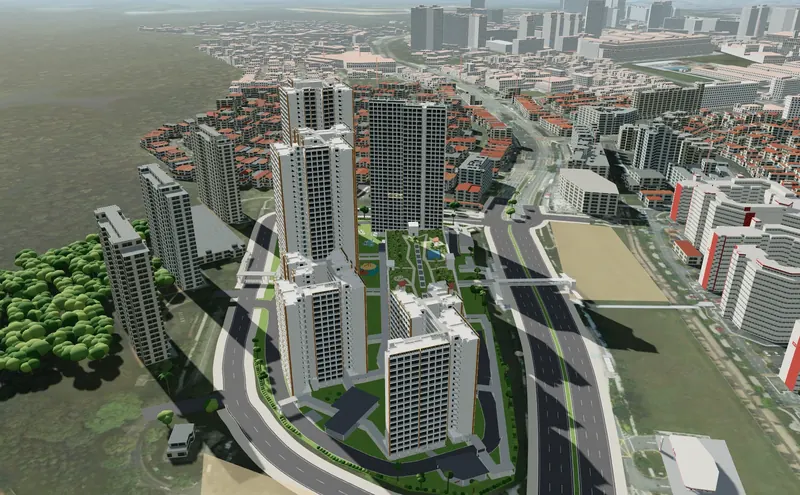
Which way does the sun move over Singapore?
Singapore is about 1.3 degrees north of the equator. All year, the sun rises in the east, passes high overhead around midday and sets in the west.
From about late March to mid-September it passes a little to the north of overhead; for the rest of the year, a little to the south. At its furthest, in June and December, the midday sun is about 22 to 25 degrees from straight up.
Singapore's clocks run ahead of the sun, so the sun is highest at around 1 pm, not at noon.
9 am
The sun is 27° above the horizon, in the east.
- North-facing windows: no direct sun
- East-facing windows: full sun
- South-facing windows: no direct sun
- West-facing windows: no direct sun
Which BTO stacks get the afternoon sun?
Homes whose windows face west get the afternoon sun. Windows facing north-west or south-west get it too, at a slant, for part of the year. Homes facing east get the morning sun instead.
Facing is only half of it. A neighbouring block, the multi-storey carpark or a building across the road can shade a stack, often its lower floors, for part of the day.
9 am. Morning: the east faces are lit and the shadows fall to the west.
Is my BTO unit facing west, and does it matter?
To find out, open the HDB brochure's site plan, find the north arrow, then find your block. The floor plan of the block shows each stack's number and which side its windows are on. The living room and bedroom windows matter most.
West-facing rooms are often warmer in the late afternoon and evening: the sun reaches them when the day is already at its hottest, and the walls give back the heat after sunset. Ledges, the block's own shape and neighbouring buildings can shade them, so check the particular stack.
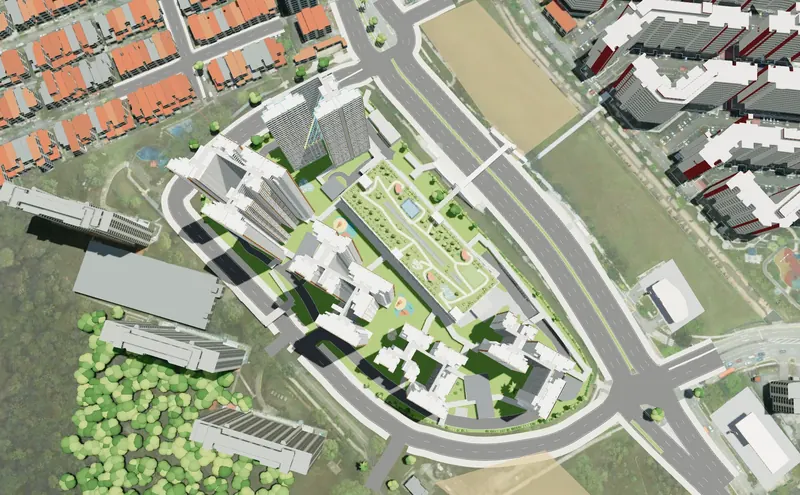
On this plan north is straight up the page, so the right-hand side is east (morning sun) and the left-hand side west (afternoon sun). On other plans north may point elsewhere.
Find its number, then turn to that block's floor plan: it shows each stack's number and which side its living room and bedroom windows are on.
Our guide How to read a brochure goes through the rest of the site plan and the floor plans.
Are north- and south-facing flats better?
Windows facing north or south get less direct sun, because the sun passes high overhead. North-facing windows get some sun in the months around June; south-facing ones, in the months around December.
Many buyers choose them for a cooler home; others want more light. It is a preference, not a rule.
June: the midday sun stands about 22° to the north of overhead, so north-facing windows get a slanting sun and south-facing ones none.
Do higher floors get more sun?
Usually, because fewer neighbours stand in the way. But a lower floor facing open ground can get more sun than a higher floor facing a taller block. It depends on the stack and on what stands around it.
Storeys 1 to 8 are in shadow; from storey 9 up, the windows see the sun over the neighbour.
What else matters when choosing a stack?
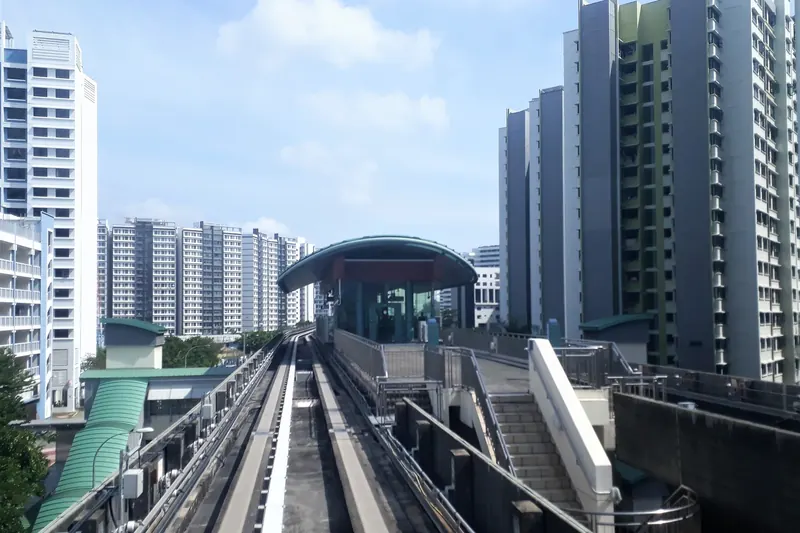
Besides sunlight: the view (open, or facing another block), noise from roads and MRT lines, how far the lift lobby and the refuse chute are, and the walk to the bus stop or MRT station.
BTOLeh's explorer shows each block with the roads, carpark and neighbouring buildings around it in 3D, so you can look at these yourself before you choose.
Our guide Which stack should you pick? takes each of these in turn.
How does BTOLeh work out sunlight?
Each project is modelled as an estimate from public information and map data, including the outlines and heights of OneMap 3D's buildings (2025, via om3d). The sun's position is worked out for the site at any date and time, and rays are traced from each home's windows and walls to find what blocks them.
Block positions and heights are approximate, so every figure is an estimate. The 3D precinct at noon is free; sunlight figures for each home are a paid feature.
Is BTOLeh part of HDB?
No. BTOLeh is independent and not affiliated with HDB. Check HDB's official material before you decide.
See it in the explorer
See the sun on your own home
This guide explains the sun over Singapore in general. In the explorer you can see it on a particular home: how much of its windows, walls and roof the sun reaches, hour by hour and across a typical year, worked out from the 3D model of its project.
Free for everyone: every project's 3D precinct at noon, building labels and nearby places, and homes coloured by flat type. The feature shown comes with a project or a whole launch.
See a project in 3D
- Berlayar Rise, Bukit Merah
- Kebun Baru Breeze and Kebun Baru Ridge, Ang Mo Kio
- Lakeview Cascadia, Bishan
- Sembawang Brook and Sembawang Portico, Sembawang
- Woodgrove Acres, Woodlands
- Kim Keat Crest, Toa Payoh
- Redhill Peaks, Bukit Merah
- Sembawang Deck and Sembawang Voyage, Sembawang
- Tampines Bliss and Tampines Nova, Tampines