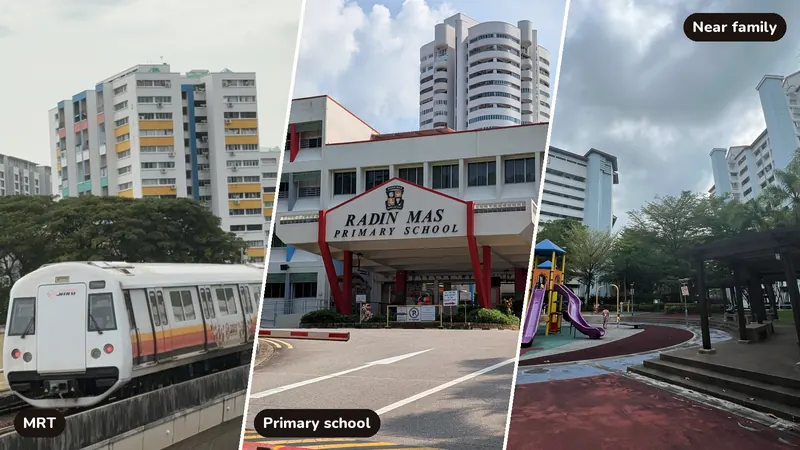
Three distances shape many BTO choices: to a primary school, to an MRT station and to parents. Two come with official rules: MOE's 1 km and 2 km bands for Primary 1 registration, and HDB's 4 km for the Family Care Scheme. The third is about daily life, and about the lines LTA is still building.
Every rule below is MOE's, HDB's or LTA's, as published on the dates in the sources at the end.
Primary 1: how distance gives priority
MOE's Primary 1 registration runs in phases. Phase 1 is for children with a sibling in the school. Phase 2A is for children whose parent or sibling studied there, whose parent works there or sits on its advisory or management committee, or who attend the MOE Kindergarten in the school. Phase 2B is for children of parent volunteers, of members of a church or clan directly connected with the school, and of endorsed community leaders. Phase 2C is open to all, and Phase 2C Supplementary is for children not yet registered after it.
When a school has more applicants than places in a phase, MOE gives priority by citizenship first, then by home–school distance. If a band still has more applicants than places, there is a ballot. Choose a household below to see where it stands.
- 1Citizens within 1 km
- 2Citizens 1 to 2 km
- 3Citizens beyond 2 km
- 4Permanent residents within 1 km
- 5Permanent residents 1 to 2 km
- 6Permanent residents beyond 2 km
A Singapore Citizen living 1 to 2 km of the school is in group 2 of 6.
How the distance is measured
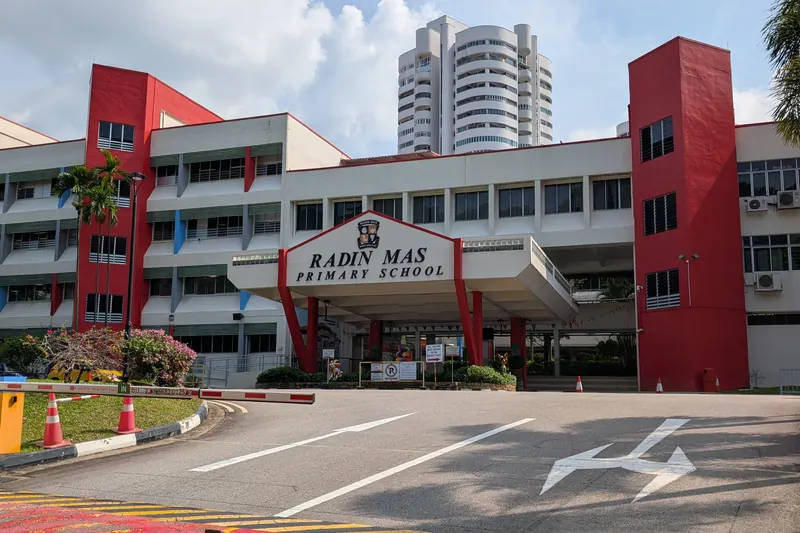
MOE takes the shortest distance from any point on the school's boundary to your home's building outline, as drawn in the plans submitted for the development. It is not measured from the school gate or to your front door, and it can change from year to year when a building outline or a school's boundary changes.
The official checker is the OneMap School Query service from the Singapore Land Authority. Its data are updated each June, ahead of that year's exercise, so check in the year you register. MOE's SchoolFinder also lists the schools within 2 km of an address.
Schools move too. MOE's own example is Kranji Primary at its new campus in Tengah: parents applying there in the 2027 exercise are asked to check their distance category in June 2027.
Registering with a BTO flat still being built
You can register with the address of a new flat before it is finished, on MOE's conditions. Its vacant possession date must fall within 2 years of your child entering Primary 1; MOE does not accept a probable completion date. For an HDB flat you send the school a copy of your Agreement for Lease, and you undertake to move in within those 2 years. MOE's example: for a child registering in 2026, the possession date must be no later than 31 December 2028.
Then the 30-month rule applies. A child admitted on distance priority must live at that address for at least 30 months, counted for a new flat from the day your family moves in, and it must become your NRIC address. If the condition is not met, MOE will transfer the child to a school of its choosing, and parents have no say in which.
Moving in Jul 2027, your family must live there until at least Jan 2030, with the flat as your NRIC address.
What to check
- Find your project's possession date in your HDB documents, not the probable completion date in a brochure.
- Check the distance category in OneMap's School Query in June of the year you register.
- Plan to make the new flat your NRIC address when you move in, and to stay 30 months.
What changes from the 2027 exercise
MOE names an exercise after the year it runs. The 2026 exercise ran from 30 June to 30 October 2026, for children starting school in January 2027. On 10 September 2026 MOE announced changes that start with the 2027 exercise, for children starting in 2028.
Phase 2C will reserve 60 places in most schools, up from 40; schools with a Primary 1 intake of fewer than 180 keep 40. Phase 2B stays at 20. How distance is measured does not change.
At 12 schools where public housing is less than 40% of the homes within 2 km, Phase 2C places will be split equally between children living within 2 km and those beyond, with no distance priority within each half. They are Anglo-Chinese School (Junior), Anglo-Chinese School (Primary), CHIJ (Katong) Primary, Methodist Girls' School (Primary), Nanyang Primary, Ngee Ann Primary, Pei Hwa Presbyterian Primary, Raffles Girls' Primary, Singapore Chinese Girls' Primary, St. Margaret's School (Primary), Tanjong Katong Primary and Tao Nan School.
The Family Care Scheme: the 4 km rule
HDB's Family Care Scheme (Proximity) helps parents and their children live together or close by. It started with the July 2025 sales exercises and replaced the Married Child Priority Scheme and part of the Senior Priority Scheme. Married and single children qualify, a single child must be 35 or older, and at least one parent or child must be a Singapore Citizen or permanent resident.
To apply under it to live near your parents or child, the nearest block of the BTO project must be within 4 km of the home they live in, which must be their NRIC address: an HDB flat, an HDB rental flat or a private home. A flat they have booked that is still being built, or a home they are buying, can count too. HDB does not publish exactly how the 4 km is measured; its Distance Enquiry for FCS e-Service, open during each sales exercise, gives the answer for your addresses.
The condition lasts. After key collection, your parents or child must keep living with you or within 4 km of your new flat for the whole minimum occupation period.
Within 4 km: you could apply under FCS (Proximity) to live near them, and they must stay within 4 km through your MOP.
What the scheme gives you
It is a share of flats, not extra ballot chances. In each BTO exercise HDB sets aside up to 30% of the flats of 3-room and above for first-timer families applying under the scheme (20% in Prime projects), with smaller shares for 2-room Flexi flats and for second-timer families. Within that quota, families applying to live with their parents or child are served first; the rest goes to those living near. HDB notes that priority schemes do not guarantee a favourable queue number.
A household may use only one priority scheme, except that one eligible for the Family and Parenthood Priority Scheme may also use one other, such as this one.
Buying resale instead? The help is different: HDB's Proximity Housing Grant gives $30,000 to live with your parents or child, or $20,000 to live within 4 km of them.
MRT: what is open, what is coming
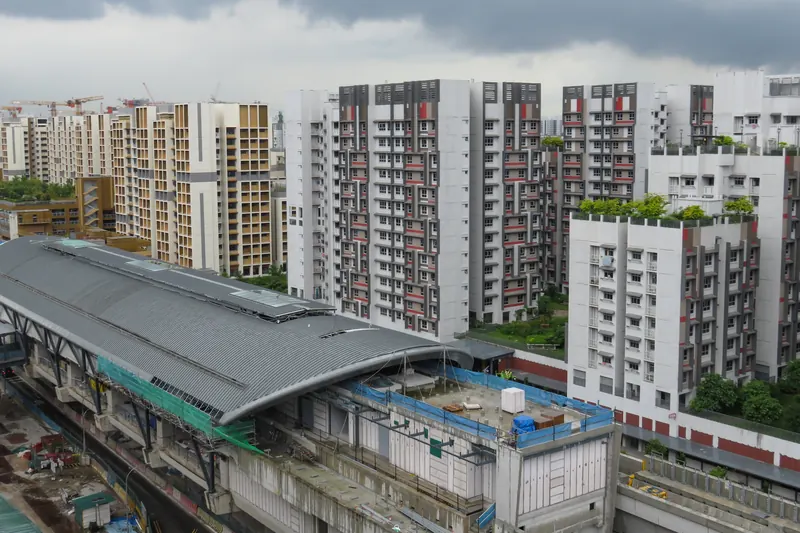
LTA's target is to expand the rail network to about 360 km by the early 2030s, connecting eight in 10 households to within 10 minutes of a train station. A BTO flat takes years to build, so a line that is under construction today may be running by the time you collect your keys, and one LTA has not given a year for may not.
- Jul 2026Circle Line stage 6Opened for passenger service on 12 July 2026.
- Dec 2026Thomson–East Coast Line stage 5 and Downtown Line 3 extensionTo open on 26 December 2026.
- 2028Jurong Region Line stages 1 and 2Choa Chu Kang to Boon Lay and Tawas; Tengah to Pandan Reservoir.
- 2029Jurong Region Line stage 3Towards NTU and Jurong Pier.
- 2030Cross Island Line phase 1Expected to be completed by 2030.
- 2032Cross Island Line phase 2 and Punggol extensionExpected in 2032.
- 2035Downtown Line 2 extensionThree stations, including Sungei Kadut.
- Late 2030sCross Island Line phase 3Jurong Lake District to Gul Circle, targeted for the late 2030s.
Judging the distance
- Look at the walk, not the straight line: covered linkways, crossings and the side of the road the station is on.
- For a line still being built, check LTA's page for its stage and year rather than a map alone.
- A station or a viaduct close by also brings people and some noise; our stack guide covers noise.
See it in the explorer
Walk the way to the road
Distances on a map are straight lines. In the explorer you can walk the precinct at eye level, along the linkways and past the void decks to the road, and see the nearby schools, stations and shops labelled around the site.
Free for everyone: every project's 3D precinct at noon, building labels and nearby places, and homes coloured by flat type. The feature shown comes with a project or a whole launch.
Sources
- MOE: Primary 1 registration
- MOE: Registration phases and key dates (updated 11 September 2026)
- MOE: Priority admission by home–school distance (updated 11 September 2026)
- MOE: Home address used for registration (including a new property) (updated 30 September 2026)
- MOE: Changes to the P1 registration framework (updated 11 September 2026)
- MOE press release: Enhancing the Primary One registration framework for greater access and inclusivity (10 September 2026)
- MOE press release: 2026 Primary One registration exercise (29 April 2026)
- OneMap, Singapore Land Authority: School Query
- HDB: Priority schemes (Family Care Scheme) (updated 23 October 2026)
- HDB: Frequently asked questions on sales exercises (updated 22 October 2026)
- HDB: New FCS (Proximity) better supports parents and children to live closer together (20 July 2025)
- HDB: Proximity Housing Grant
- LTA: Upcoming projects: rail expansion (updated 8 July 2026)
- LTA news release: TEL5 and DTL3e to open for passenger service on 26 December 2026 (4 November 2026)
- LTA: Cross Island Line (updated 4 August 2026)
- LTA: Jurong Region Line (updated 17 March 2026)
- LTA: Downtown Line 2 and 3 extensions (updated 15 January 2026)
- LTA: Circle Line stage 6 (updated 3 September 2026)